

A SaaS Playbook for Reducing in Force: Survivors Guide

In companies with 20 to 250 employees, Human Resources is often a team of one or maybe two. More often than not, that HR leader has been there since the early days, witnessing the company secure venture capital backing, scale quickly, and grow from a scrappy startup into a real business.
With that growth came new expectations. Capital infusion required structure. Policies had to be built. Processes had to be standardized. Headcount doubled and, in some cases, tripled almost overnight.
Then the environment shifts.
Annual Recurring Revenue (ARR) slows. Subscription cancellations increase. Churn rises. Monthly expenses, also known as burn, suddenly become impossible to ignore.
That’s when the questions start creeping in:
Will we run out of money?
Will our investors lose confidence in us?
Can we survive long enough to stabilize and grow again?
As these concerns become reality and investor pressure intensifies, leadership teams are often pushed toward a reduction in force to slow the burn. For many HR leaders, Founders, CEOs, and COOs, especially those navigating this for the first time, the moment feels overwhelming and the uncertainty is real. The stakes are high. And the fear of making the wrong decision can be paralyzing.
But reducing headcount does not have to be a reaction driven by panic or pressure.
When approached intentionally, a reduction in force can be a strategic reset. One that protects the business, preserves trust with employees and investors, and positions the company to survive long enough to course correct. This article provides a practical playbook for VC-backed SaaS companies on how to approach workforce reductions with clarity and structure: starting with deciding what work truly matters, minimizing legal and reputational risk, and supporting impacted employees in a way that reflects the company’s values.
This is not about moving fast and breaking people. It’s about making hard decisions the right way so the company, and the people who built it, have a future.
Before deciding what to cut, leadership must be aligned on where the company is going. Without this clarity, layoffs become arbitrary and risk doing more harm than good.
Define The Future
What products are we fully committed to? Meaning: If money were tight, which product would we bet the company on?
Ask Yourself: Which product generates most revenue? - Which product must survive for the company to exist? - Which products are experiments or add-ons?
Which customers matter most? Meaning: Not all customers are equal.
Ask Yourself: Who pays the most? - Who stays the longest? - Who costs the least to support? These answers guide you to which teams matter most.
Phase I. Preliminary Questions
Ask and document the answers to these 5 important questions.
1. Why are you considering layoffs?
2. How many people might be impacted?
3. What’s your timeline?
4. What states/countries are your employees in?
5. Has a decision been made yet or are options still being evaluated?
Phase II. Decide what work goes away (not who)
List all the work your company does then sort them into four categories.
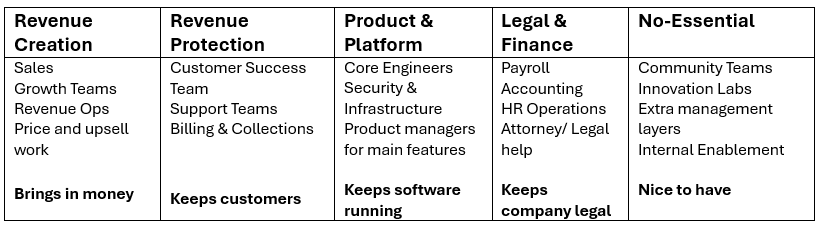
Work listed as “Non-Essential” is at the highest risk. These roles are helpful, but the company can survive without them.
Only after work is cut, then decide who is impacted
Ask Consistently: - Does This Role Still Exist? - Are There Duplicate Roles? - Do Skills Match Remaining Work?
Phase III. Evaluating Legal and Reputational Risk
Part 1. Consistency Check (Most Important)
Ask Yourself: Are we applying the same questions across teams?
Bad example: Marketing cut based on performance - Engineering cut whole teams - Sales untouched
Good example: Across ALL teams, leadership asks: 1. Does this work still exist? 2. Does it support the future state? 3. Is it duplicated elsewhere?
Part 2. Warn Act Awareness
A law requiring advance notice for large layoffs, 50 or more employees within a 30-day period, depending on location.
Part 3. OWBPA (Age 40+ Protection)
If employees age 40+ are impacted AND severance is offered: - Extra review time required – employees have the right to revoke - Group age disclosure needed
Ask Yourself: Are employees over 40 impacted? - Has this been reviewed with counsel?
Part 4. Disparate Impact
Ask Yourself: - Do results look unfair on paper? - Are protected groups heavily impacted?
Part 5. NDAs & Non-Competes
Ask Yourself: What agreements are employees bound by? - Are restrictions enforceable in their state? - Is language overly aggressive?
Part 6. Following Your Own Rules
Ask Yourself: What does our employee handbook say? - Have we followed this process before? - Are we breaking our own policies?
Phase IV. Severance & Transition Design
Will you provide transition assistance and support to laid-off employees?
1. Severance pay (weeks or months)
2. Benefits continuation (EAP, insurance)
3. Outplacement support
Phase V. Notification Day Support
Part 1. Prepare leaders and HR for notification day
1. Plan the order of meetings
2. Decide what managers will say
3. Prepare written materials
4. Set expectations for questions
Introduce outplacement Immediately
If outplacement is provided, employees should hear about it the same day as notification. If severance is offered, provide documentation promptly.
Phase VI. Last day of employment
Ensure employees receive:
Final paycheck
COBRA information
Unemployment benefits details
PTO payout (if applicable)
Retirement account information
Tax documents
When capital tightens and investor pressure increases, decisions often feel rushed and high risk. Leaders are asked to reduce burn quickly while worrying about lawsuits, employee trust, and public perception all at the same time.
But investors are not looking for speed alone. They are looking for judgment.
A poorly planned reduction in force creates legal, operational, and reputational risk that can undermine confidence faster than missed targets. A thoughtful one signals control. It shows leadership understands the business, knows what work truly matters, and can make hard decisions without destabilizing the company.
Reducing headcount is not just a cost decision, it is a credibility moment. When done with clarity, consistency, and care, it protects enterprise value, preserves trust, and positions the company to survive long enough to recover.
How you reduce today determines what you are able to build tomorrow.
