

The Executive’s Mirror of Reflection

“Executives often lead layoffs but, when was the last time you considered how vulnerable your own position is?”
Vice presidents who oversee Operations, Finance, Sales, Marketing, IT, and HR sit at the very center of layoff planning. They are the ones who identify declining margins, rising costs, operational inefficiencies, or shifts in performance indicators. They determine which departments need restructuring, which tasks can be automated, which functions can be outsourced, and which roles no longer align with the company’s strategic direction. Once those decisions are finalized, the employees connected to those tasks are placed on the layoff list. Most of the time, there is no connection or relationship with the employees on the list. Their badge photo that was used to map out the layoff was the executives first time viewing their employees and learning their names. The disconnect isn’t rooted in malice; it is simply the reality of leadership workload, tight schedules, and the distance that naturally forms as responsibilities grow. After the workforce reduction plan is drafted, severance calculations are made and outplacement services are determined. The process then moves downward to directors and managers who are tasked with delivering the news and witnessing firsthand the emotional, mental, and financial consequences that layoffs inflict on the individuals behind the spreadsheet.
These real and often painful experiences are echoed on the Let’s Talk Layoffs Podcast, hosted by Antonio and Andy, where people who have been laid off share the internal journey that follows job loss. The podcast creates a space for transparency, emotional processing, and the kind of storytelling that reveals the truth behind terms like “labor reduction” and “organizational restructuring.” These conversations highlight what spreadsheets cannot: the shock, the grief, the fear, the confusion, and eventually the resilience that follows displacement.

One story that captures the emotional depth of layoffs appears in Episode Five, titled My Layoff Broke My Spirit but Nourished My Passion, featuring Chef Scott McDonald. Chef Scott described the highest peaks of his career, winning Food Network’s “Chopped,” helping open fifteen restaurants in five years, and playing an instrumental leadership role in maintaining operations. When the company entered a transition period, he was told his job was no longer needed. The layoff sent him into a three-to-four-year journey of self-discovery and healing as he grappled with the emotional and mental toll of losing the role that once defined him. His story could have ended there, but what happened next illustrates the unpredictable nature of layoffs. After rebuilding his career and joining a financially strong company, one that had recently raised a billion dollars, he was congratulated publicly with a plaque for his performance, given a raise, and recognized as one of the company’s top contributors. Just two weeks later, he opened an email informing him that he had been laid off and that his belongings were waiting for him on the loading dock. The suddenness of the moment, paired with the emotional betrayal of having been celebrated days before, overwhelmed him with fear, guilt, anger, and sadness. His story is a reminder that every number on a layoff list represents a human life with responsibilities, families, dreams, and fears. His experience goes far beyond the Excel sheet used to determine headcount.
Although the podcast episode did not explicitly mention his title, the responsibilities McDonald held mirrored those of an executive. He was leading operations, setting direction, making high-level decisions, and overseeing the daily functioning of the organization. His experience aligns with labor reports from the last two years, which show a sharp rise in vice presidents, senior vice presidents, and executive vice presidents appearing on layoff lists. Executives are no longer shielded from workforce reductions. As companies shift into leaner business models, adjust to the post-pandemic employment landscape, adopt artificial intelligence to streamline processes, and react to unpredictable economic trends, layoffs have reached all levels of the organizational chart.
Executives often feel more insulated because of the strength of their networks, their industry reputation, advanced expertise, and resumes stacked with achievements. For many, a layoff has traditionally been seen as an inconvenient disruption rather than a devastating setback, and in some cases, it has even opened the door to a higher-level role. However, the data now tells a different story. In the last 2 years, executives have experienced the longest periods of unemployment before securing their next role, with many remaining unemployed for six months to over a year. Companies are more cautious in their hiring and compensation strategies, leaving little room for negotiation. Sales bonuses, leadership incentives, and salary flexibility have decreased, contributing to longer transitions between jobs.
A growing skills gap is also widening the challenge. As technology accelerates, companies expect senior leaders to be fluent in marketing, social media, AI, automation, and digital business tools. Yet as executives rise, much of their hands-on technical work shifts to their teams, leaving them focused mainly on leadership and communication. While these soft skills matter, today’s market requires both. Leaders who haven’t kept up with digital trends often face longer job searches and extended interview cycles.
Chart A. Long-Term Unemployed by Occupation (27+ Weeks, 2024)
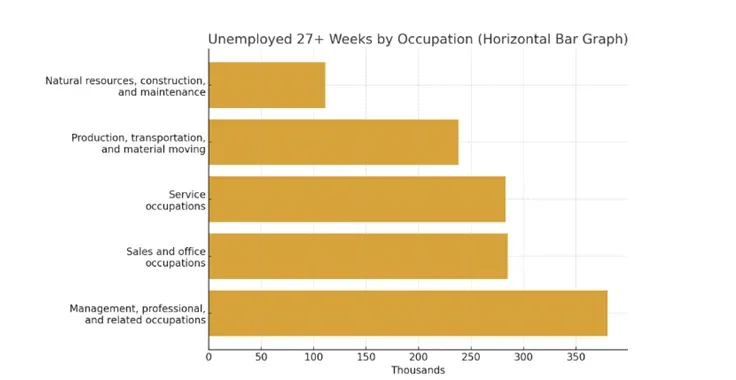
The chart shows long-term unemployment (27+ weeks) across major occupations in 2024. Management, Professional, and Related Occupations holds the largest share, with 380,000 people unemployed for over six months. This highlights that long-term joblessness is most concentrated among experienced leaders and highly skilled professionals, exceeding all other occupational groups. Source: U.S. Bureau of Labor Statistics (BLS), Current Population Survey, Table A-32: Unemployed persons by occupation and duration of unemployment. Available at bls.gov/cps/cpsaat32.htm.
This shift is echoed by HR Director Oumar Traoré, who sees firsthand why executives are taking longer to re-enter the workforce:
“One factor is that we’re still in a period of flux after the pandemic. Companies are underperforming and being extremely careful with spending, especially at the executive level.
The other piece is AI—it’s changing everything. Many companies are lowering roles and hiring junior people because AI now gives them the efficiency that used to require an executive. With tighter budgets and AI boosting what junior talent can do, it’s getting harder for executives to find their way back into the job market.”
— Oumar Traoré, HR Director at HireVue
The emotional impact of layoffs, whether experienced by employees or executives, can be profound. The sense of identity, stability, and forward momentum is abruptly interrupted. This is why empathy should guide every decision an executive makes during workforce reductions. Even when budgets are tight and severance packages are limited or unavailable, empathy can still be expressed through intentional actions. Providing a reference letter costs nothing but can be invaluable to someone navigating their job search. Offering outplacement support, even at the most basic level, can help an employee regain clarity and direction. And when budgets are strained, there are community resources such as CareerSource that provide career transition assistance at no cost to the employer or the employee. A simple referral to these resources can make a significant difference.
Empathy does not always need to be financial. It can be expressed through time, compassion, and thoughtful communication. It shows up when leaders prepare carefully for layoff conversations, deliver the message with respect, and offer support that honors the dignity of the individual being affected.
I titled this article The Executive’s Mirror of Reflection because self-awareness is one of the most important leadership competencies, especially during layoffs. Emotional intelligence must be continuously developed. The next time you must make a layoff decision, pause long enough to put yourself in the shoes of those on the list. Ask yourself how you would want the news delivered if you were the one being laid off. Would you want an email, or would you want a conversation? Would you want to walk away empty-handed, or would you hope for guidance, resources, or a connection to help you transition? In every restructuring, consider not just the business implications but the human experience. And remember--leadership begins with humanity.
